
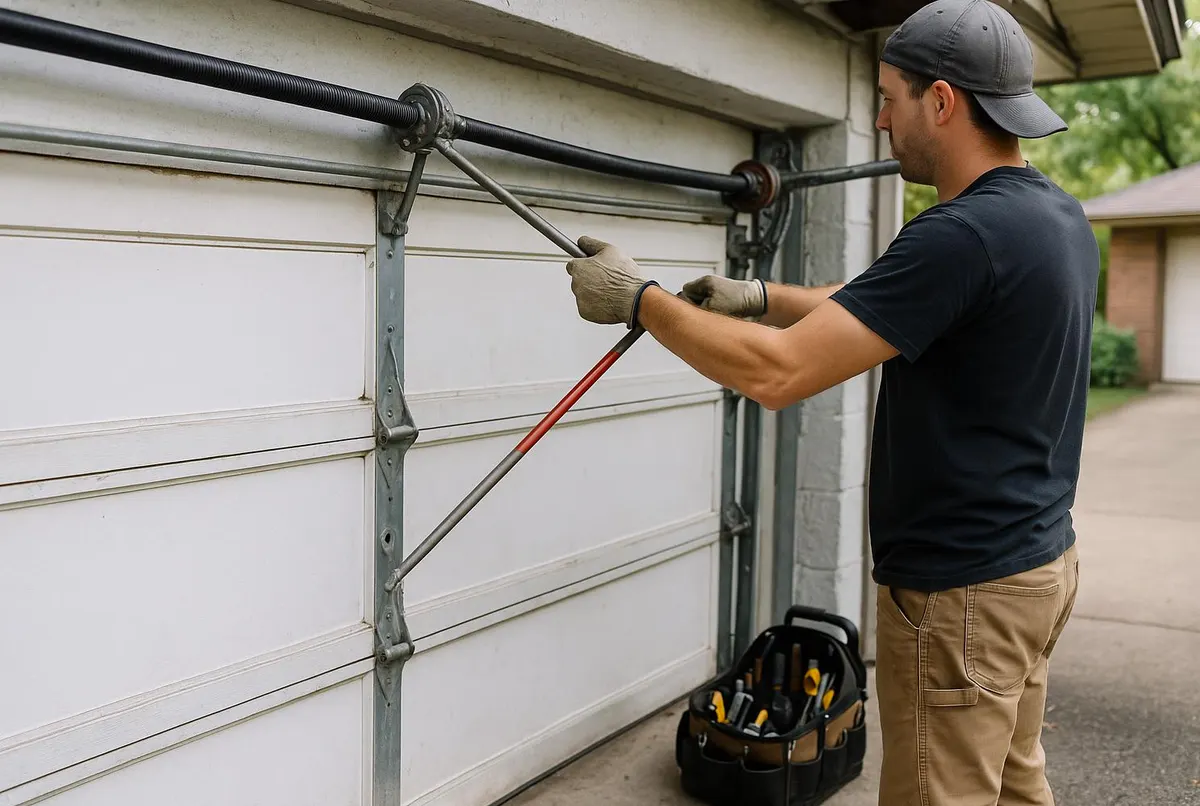
The Moment You Notice It
You're backing the car out before work, half paying attention, when the door starts up smooth and then catches — a metallic scrape, a little hop, like it's fighting itself on one side. You look up and the bottom panel isn't level. One corner is riding higher than the other, and there's a sliver of daylight between a roller and the track that wasn't there last month. The door still runs, technically, but it doesn't look right, and it doesn't sound right either.
That's usually a track problem, not a spring or opener problem. Tracks don't fail all at once — they drift out of alignment gradually, and the first clue is almost always something you notice with your ears or your eyes before the door ever stops working completely.
Symptoms to Watch For
- Grinding or scraping noise as the door travels, especially near the same spot in the cycle every time.
- Visible gap between a roller and the track, or a track that bows outward instead of running in a straight vertical line.
- A crooked door when fully open — one side sits higher than the other, or the whole panel looks tilted.
- Binding or hesitation partway through opening or closing, like the door is pushing against resistance.
- Rollers popping out of the track, sometimes dramatically, sometimes just enough that the door drags.
- Rust or flaking along the track seams, particularly near the bottom where water tends to sit after a storm.
Any one of these on its own might be minor. Several together usually mean the track has shifted enough that it needs attention before it gets worse.
What a Technician Checks, in Order
1. Visual Alignment Down the Track
The first thing a tech does is stand back and sight down the length of each vertical track, looking for bows, kinks, or sections that lean away from the wall. A healthy track runs arrow-straight. Even a small bend — sometimes less than an inch — is enough to make rollers bind or jump the groove.
2. Brackets and Fasteners
Next comes the hardware holding the track to the jamb. Vibration from daily use, plus humidity swings that make wood jambs swell and shrink, can work lag bolts loose over time. A bracket that's pulled even slightly away from the frame lets the whole track flex every time the door moves, which accelerates wear and eventually causes visible misalignment.
3. Impact Damage
Tracks get hit more often than people expect — a car bumper, a bike, a ladder leaned the wrong way, or debris during a storm. A single impact can crease the track just enough to catch a roller every cycle. This is usually obvious once you know to look for it: a dent or flat spot right at roller height.
4. Rust and Corrosion at the Seams
In this part of Florida, humidity and salt-tinged air do real damage to exposed metal, and track seams are a common weak point. Rust pits the metal, which weakens it and lets it warp under normal operating stress. Afternoon downpours that sit in the lower track sections make this worse, especially on doors that don't get wiped down or inspected after storms.
5. Jamb Movement
Because tracks are fastened directly to the wood door jamb, seasonal moisture swings matter. Humid summers swell the wood slightly; drier stretches let it shrink back. That constant small movement, repeated year after year, can pull brackets out of true alignment even when nothing was ever struck or damaged.
6. Worn Rollers Contributing to Track Wear
Worn or cracked rollers don't bend a track by themselves, but they ride roughly inside it, and over months that rough contact wears a groove or chips the track edge. If rollers are replaced without addressing a track that's already taken damage, the noise often comes right back.
What the Fix Actually Involves
For minor bends, a technician uses a rubber mallet and a track gauge to coax the metal back into a true line, then re-anchors the brackets so it holds. For a crease, dent, or section that's rusted through, replacing that segment of track is usually more reliable than trying to straighten it — a repaired bend can work-harden and bend again in the same spot. After any track work, the door gets run through a full cycle to check balance and make sure the panels roll smoothly without binding, since a straightened track that's still slightly off can cause the same symptoms to resurface within weeks.
When to Call Lawtey Garage Door Service
If your door is scraping, hopping, or hanging crooked when open, it's worth having it looked at before a roller pops free entirely or the opener starts straining against the resistance. Our Off Track Door Repair service covers exactly this — realignment, bracket repair, and track section replacement where corrosion or impact damage has gone too far. If it's been a while since anyone's checked your hardware, our Garage Door Maintenance & Tune-Up catches loose brackets and early rust before hurricane season turns them into a bigger repair.
If your garage door in Lawtey, FL is scraping, sticking, or sitting crooked, call Lawtey Garage Door Service and we'll get it running straight again.